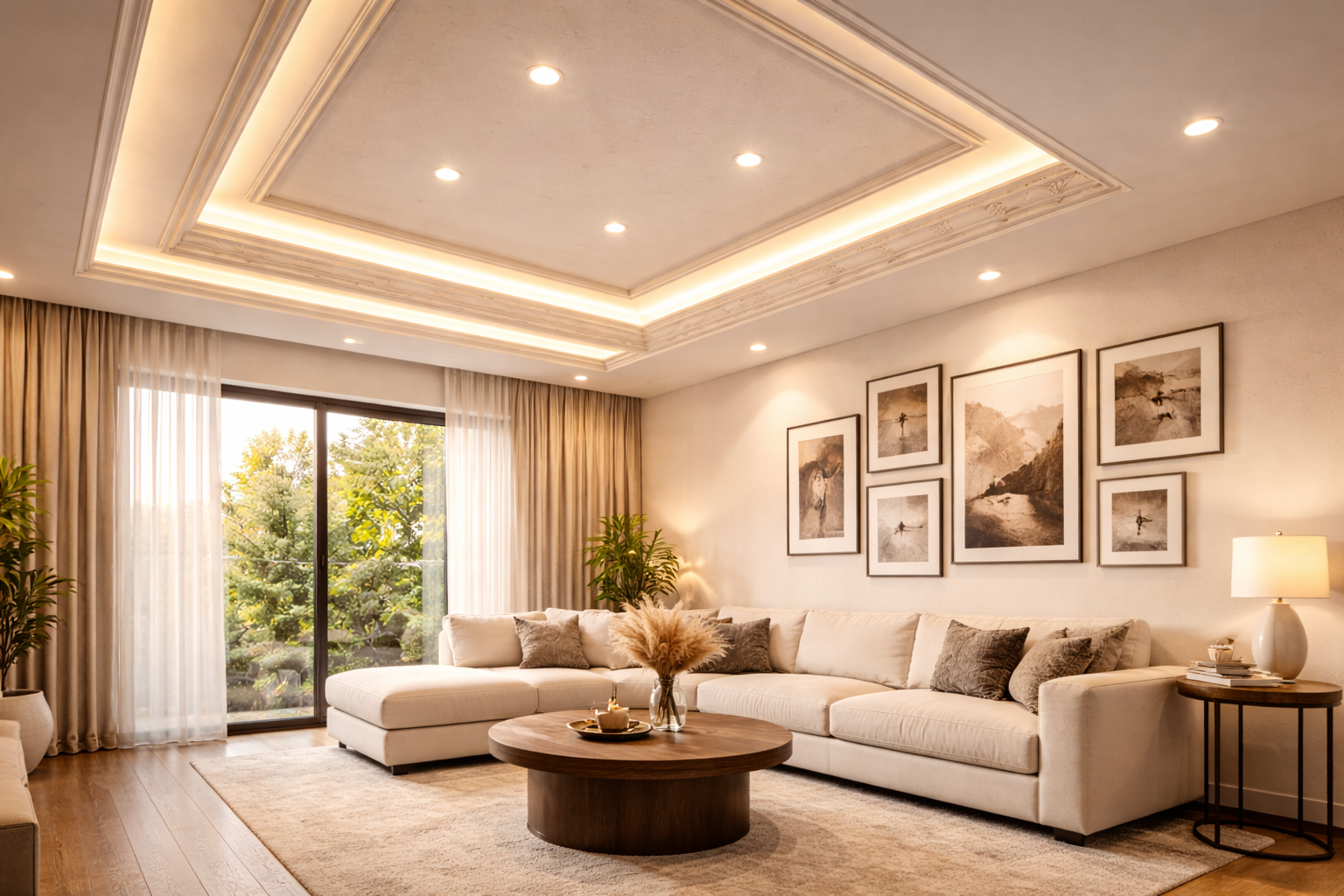
The living room ceiling is the most visible surface in your home — and the one with the greatest potential to set the entire tone of your interior. A well-designed false ceiling in your living room can make a compact apartment feel taller and more open, create a focal point that anchors your furniture arrangement, conceal ugly electrical conduits and AC units, and integrate lighting that transforms the room's atmosphere from day to night. In Indian homes, particularly in Bangalore's growing number of premium apartments and villas, the living room false ceiling has become an essential design element rather than a luxury add-on. This guide covers the most effective false ceiling design styles for Indian living rooms — what each style achieves, when it works best, and how to choose the right approach for your space.
Why the living room ceiling matters most
Unlike bedrooms or kitchens, the living room is experienced by everyone who enters your home — family, guests, and visitors. It is also the room where ceiling design interacts most directly with other design decisions: furniture layout, lighting mood, TV placement, and the overall style you are going for. A flat builder ceiling with a single pendant light delivers basic function. A thoughtfully designed false ceiling with integrated lighting zones, well-proportioned levels, and good material choices delivers an entirely different experience — one that makes your living room feel considered, premium, and personally designed.
Tray ceiling designs
The tray ceiling is the most popular false ceiling design in Bangalore living rooms. It consists of a peripheral border ceiling (typically 6 to 12 inches lower than the centre) that creates the appearance of a recessed central panel — like an inverted tray. The border is the ideal location for cove lighting: LED strips hidden within the perimeter channel cast indirect light upward, creating a warm, floating-ceiling effect. The central zone can remain flat or have additional levels added. Tray ceilings work in rooms with ceiling heights of 9 feet or above — below that, the drop can feel cramped. They are executed in both POP and gypsum, and are well-suited to rectangular living rooms.
Cove ceiling with LED lighting
A cove ceiling uses a curved or angular recess built into the ceiling plane to conceal LED strip lighting — the light source is hidden, and only the light effect (cast upward onto the ceiling or downward into the room) is visible. Cove lighting softens a room dramatically, eliminating the harshness of direct light sources. In living rooms, cove lighting is often used in combination with a tray ceiling or peripheral border, but it can also run along one or two feature walls without a full ceiling treatment. POP is particularly well-suited to cove profiles because it can be shaped into smooth curves; gypsum requires angled channel profiles instead of true curves.
Coffered ceiling designs
A coffered ceiling features a grid of recessed panels separated by raised beams or ribs, creating a structured, architectural look inspired by classical European interiors. In Indian homes, coffered ceilings work particularly well in larger living rooms (18 feet or more in any direction) where the ceiling area is large enough for the pattern to read well. The recessed panels can incorporate lighting, and the raised grid can be finished in a contrasting colour or material to create depth. Coffered ceilings are typically executed in POP — the complexity of the joinery makes on-site plastering more practical than panel cutting.
Multi-level layered ceilings
Multi-level ceilings use two, three, or more distinct ceiling planes at different heights to create zones within the living room — a lower section over the seating area, a higher section over the dining or entry zone, and transitions between them. Each level can have its own lighting treatment, creating defined areas without physical partition walls. Multi-level designs work well in open-plan living rooms where the ceiling is the only element available to define spatial zones. They require careful planning to ensure each level drops proportionally without making any zone feel uncomfortably low — the minimum finished ceiling height for any level should ideally be 8.5 feet.
Minimal flat ceiling with recessed lights
Not every living room needs an elaborate tray or multi-level design. In modern minimalist interiors — increasingly popular across Bangalore's premium apartments — a flat gypsum false ceiling with precisely positioned recessed downlights creates a clean, gallery-like atmosphere that lets furniture and artwork carry the design. The key to making a flat ceiling feel intentional is lighting design: a mix of ambient downlights and accent spots, positioned on a calculated grid, creates visual interest without architectural complexity. This approach also maximises ceiling height, which matters in rooms with existing height constraints.
Peripheral false ceiling (centre open)
The peripheral false ceiling is a variation where the ceiling treatment is applied only around the perimeter of the room, with the centre left at the original ceiling height. This creates a defined border with integrated lighting while preserving as much headroom as possible in the centre. The peripheral border typically runs 2 to 3 feet in from the walls, leaving a clear central zone. This design is particularly effective for compact living rooms (under 200 sq.ft) or rooms with ceiling heights below 9 feet, where a full false ceiling would feel too low. The border can incorporate cove lighting, recessed downlights, or both.
Choosing the right design for your ceiling height
Ceiling height is the single most important constraint on false ceiling design. As a guide: rooms with ceiling heights of 10 feet or above can accommodate any design, including multi-level and coffered. Rooms with 9 to 10 feet can accommodate tray ceilings and cove designs with a drop of up to 8 inches. Rooms with 8.5 to 9 feet work best with peripheral borders or flat ceilings with recessed lights — a full tray would leave too little headroom. Rooms below 8.5 feet should be treated with extreme care — a minimal peripheral border or no false ceiling at all may be the right choice.
Integrating AC, fans, and lights into ceiling design
In most Bangalore living rooms, the ceiling must accommodate at least one ceiling fan, an AC indoor unit or duct diffuser, and multiple light points. The false ceiling design must plan for all of these before work begins. Fan points need a concrete sleeve or anchor block above the false ceiling for safe hanging. AC units are typically concealed within a purpose-built enclosure within the ceiling border, with ventilation slots and a return air gap. Light points — including the layout of downlights, pendants, and cove strips — must be finalised before wiring begins. We plan all of this during the consultation and site visit stage, before any framework goes up.
Getting started with Elysian
We have executed living room ceilings across a wide range of styles, ceiling heights, and room sizes in Bangalore — from straightforward flat gypsum ceilings in compact 2BHKs to elaborate multi-level POP designs in large villas. Browse our project portfolio to see completed examples, or explore our POP false ceiling and gypsum false ceiling service pages for material details. To discuss your specific living room, book a free site visit — we will assess your space and give you clear design recommendations.
"Ready to design your living room ceiling? Book a free site visit and let us plan the right ceiling for your space."
Book a Free Site Visit