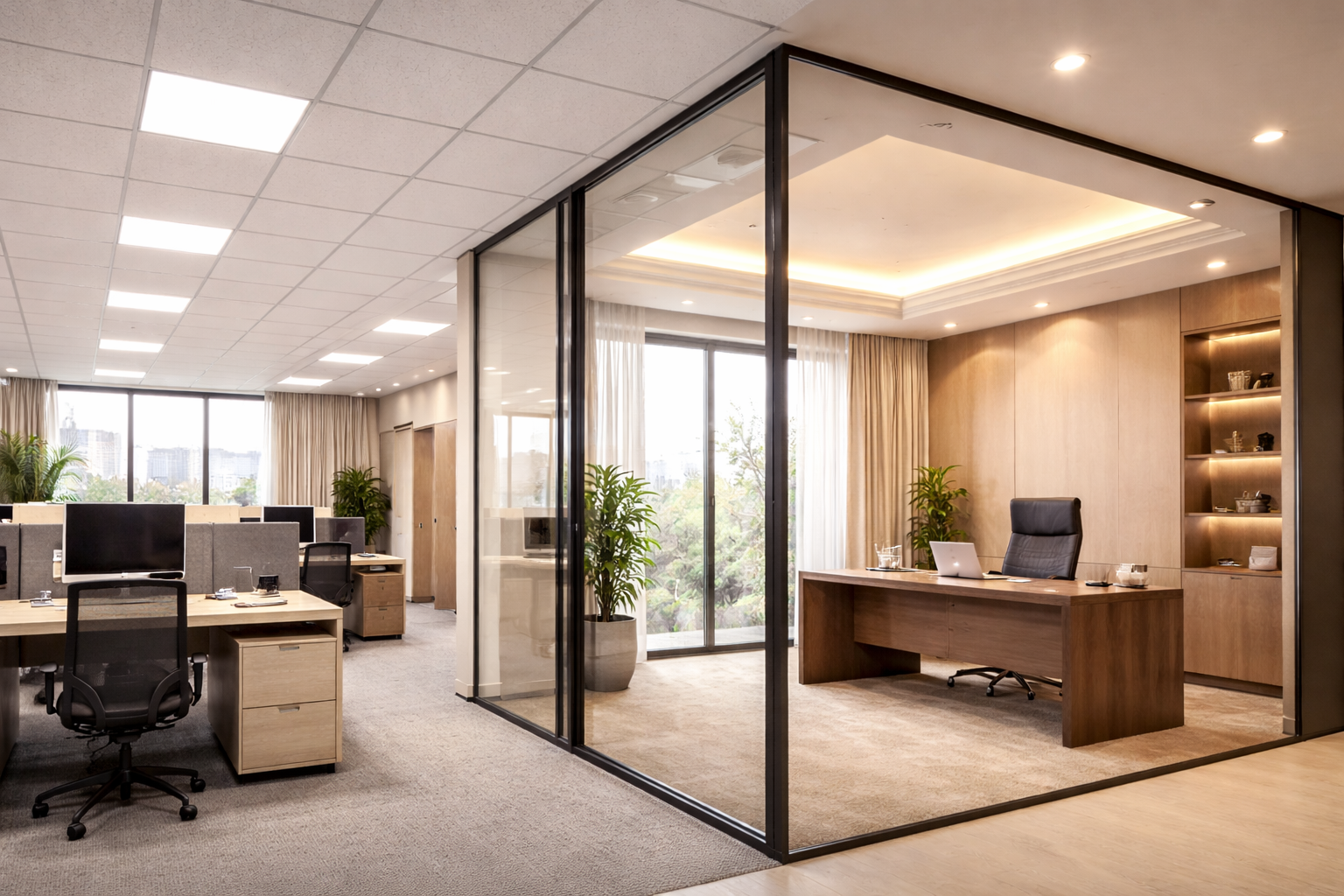
When fitting out or renovating an office in Bangalore, the ceiling decision often comes down to two options: an Armstrong grid ceiling or a gypsum board false ceiling. Both are widely used in commercial spaces across the city, but they serve different purposes, perform differently in key areas, and create very different aesthetics. The right choice depends on your office type, the services running above the ceiling, your acoustic requirements, and how much access you need to the ceiling void for future maintenance. This guide covers every relevant dimension of the comparison — from acoustic performance and fire safety to aesthetics and long-term practicality — so you can choose with confidence. For context on how these materials behave in residential settings, our POP vs gypsum comparison guide covers the residential angle in detail.
What is a grid ceiling?
A grid ceiling — also called a suspended or lay-in ceiling — consists of a visible metal T-bar framework arranged in a regular grid pattern, typically 600 × 600 mm or 600 × 1200 mm, with ceiling tiles laid into the grid from above. The tiles can be lifted out individually at any time, giving instant access to the void above — where electrical wiring, data cabling, plumbing, fire suppression pipes, and HVAC ducting typically run. Our grid ceiling service uses Armstrong and USG Boral systems, which are the industry benchmark for commercial applications in India. Grid ceilings are the standard for offices, clinics, schools, retail stores, and any space where above-ceiling access is a regular requirement. The T-bar framework is visible from below, which contributes to the characteristic modular, commercial aesthetic that grid ceilings are associated with.
What is a gypsum board ceiling?
A gypsum board ceiling uses factory-manufactured plasterboard panels fixed to a concealed GI metal framework. Once installed, the framework is entirely hidden and the surface is continuous — painted to match walls, with no visible grid lines. Openings for lights, AC diffusers, and other fixtures are pre-cut before installation. Once sealed, the ceiling void is not accessible without cutting or removing ceiling sections. Our gypsum false ceiling service uses Saint-Gobain Gyproc boards as standard. Gypsum ceilings are widely used in residential settings, but they are also common in commercial offices — particularly where aesthetics are a priority and the above-ceiling services are already finalised and unlikely to change.
Key differences for office environments
The most fundamental difference for commercial use is access. Grid ceilings allow any tile to be lifted in seconds — a facility manager can reach any cable run, pipe, or diffuser above the ceiling without any tools or disruption to the office below. Gypsum ceilings are sealed: accessing anything above requires cutting a hole, patching it afterward, and repainting. In dynamic office environments where cabling layouts change as teams move and grow, this makes grid ceilings significantly more practical. For offices with a stable, finalised layout — a dedicated server room, a boardroom, a private cabin — gypsum's cleaner aesthetic may be worth the trade-off in accessibility.
Acoustic comparison
Acoustic performance is a critical factor for open-plan offices in Bangalore, where ambient noise affects productivity and communication quality. Armstrong and USG Boral acoustic mineral fibre tiles carry Noise Reduction Coefficient (NRC) ratings of 0.55 to 0.90, depending on the tile specification. A ceiling with NRC 0.80 absorbs 80% of incident sound energy, substantially reducing the reverberant noise that accumulates in open-plan spaces. Standard gypsum board, by contrast, is reflective — sound bounces off it rather than being absorbed. To achieve acoustic control with gypsum ceilings, glasswool or acoustic batts must be laid above the boards, which adds cost and complexity. For open-plan offices where acoustic comfort matters, grid ceilings with high-NRC tiles are the more efficient solution.
Maintenance access
This is where grid ceilings are unambiguously superior for office applications. Every tile is lift-out accessible — IT infrastructure teams can route new data cables, electricians can add circuits, and HVAC engineers can adjust diffuser positions without disrupting work below. The grid can also be partially disassembled and reassembled if a major partition reconfiguration changes the space below. With gypsum ceilings, any above-ceiling work requires opening the ceiling surface and making good afterward. In offices that anticipate growth, reorganisation, or frequent IT changes, this recurring cost and disruption adds up significantly over time. Gypsum ceilings suit offices where the layout is fixed and maintenance events are rare and predictable.
Fire safety
Both systems offer fire safety options, but in different ways. Armstrong and USG Boral grid tiles carry fire resistance ratings that meet the National Building Code's requirements for commercial interiors. The mineral fibre tile composition naturally slows fire spread. Gypsum board also has inherent fire resistance — standard Gyproc provides 30 to 60 minutes, and fire-rated boards achieve 90 minutes or more. For compliance purposes, both systems can meet commercial fire safety requirements; the specific product specification must be confirmed against the building's fire engineer's report. In practice, grid ceilings are often easier to verify for compliance because the tiles are type-approved products with published ratings, while gypsum fire-rated assemblies require full system certification.
Aesthetics
Gypsum ceilings are generally considered more premium in appearance. The continuous, seamless surface with no visible grid lines reads as more refined and architectural — appropriate for boardrooms, reception areas, premium co-working spaces, and leadership offices. Grid ceilings carry a more utilitarian, commercial aesthetic that some companies find too institutional. However, grid ceiling aesthetics have improved considerably with modern products — designer tile textures, coloured grid systems, and combination approaches (gypsum panels in visible areas, grid above workstations) can create sophisticated results. The choice often reflects brand and design intent: a creative agency may prefer exposed services above a grid; a legal firm may prefer the cleaner look of gypsum throughout.
Which to choose for your Bangalore office
For most standard open-plan office fitouts in Bangalore — IT companies, startups, BPOs, co-working spaces — grid ceilings with acoustic tiles are the practical choice. The access, the acoustic performance, and the speed of installation make them the commercial standard for good reason. For reception areas, boardrooms, executive cabins, and any space where aesthetics are prioritised and above-ceiling access is not a regular need, gypsum delivers a more polished result. Many of our commercial projects in Electronic City, Marathahalli, and Koramangala combine both — grid above workstation areas, gypsum in meeting rooms and reception — getting the best of each system where it matters most.
Elysian's recommendation
We install both systems regularly across Bangalore commercial projects, and we recommend based on your specific brief — not based on what is easier for us to install. During our free site visit, we assess your floor plate, discuss your layout plans, understand your IT and HVAC requirements, and give you a straightforward recommendation on which system — or which combination — suits your project. Get in touch to start the conversation.
"Planning an office fitout in Bangalore? Let us assess your space and recommend the right ceiling system."
Book a Free Site Visit