When creating room divisions in a Bangalore office — whether for cabins, conference rooms, manager zones, or quiet focus areas — the choice between gypsum drywall partitions and glass partitions is one of the most consequential decisions in the fitout. Both approaches create effective spatial divisions, but they serve different purposes, perform differently across key criteria, and communicate different things about your workplace culture. This guide compares gypsum and glass office partitions across privacy, acoustics, fire safety, aesthetics, and installation practicality — so you can choose the approach that genuinely suits your office and team. For ceiling options for those same spaces, our grid vs gypsum guide covers the ceiling decision in depth.
Understanding gypsum partitions
Gypsum drywall partitions consist of a steel stud and track framework clad on both sides with gypsum plasterboard. The cavity between the two faces can be left empty or filled with glasswool for sound insulation. The resulting wall looks and feels like a conventional masonry partition — it can be painted to any colour, tiled, or fitted with shelving and TV mounts. It provides complete visual privacy, excellent acoustic performance when properly insulated, and inherent fire resistance. Our gypsum partition service uses Saint-Gobain Gyproc or USG Boral boards across single-layer and double-layer configurations.
Understanding glass partitions
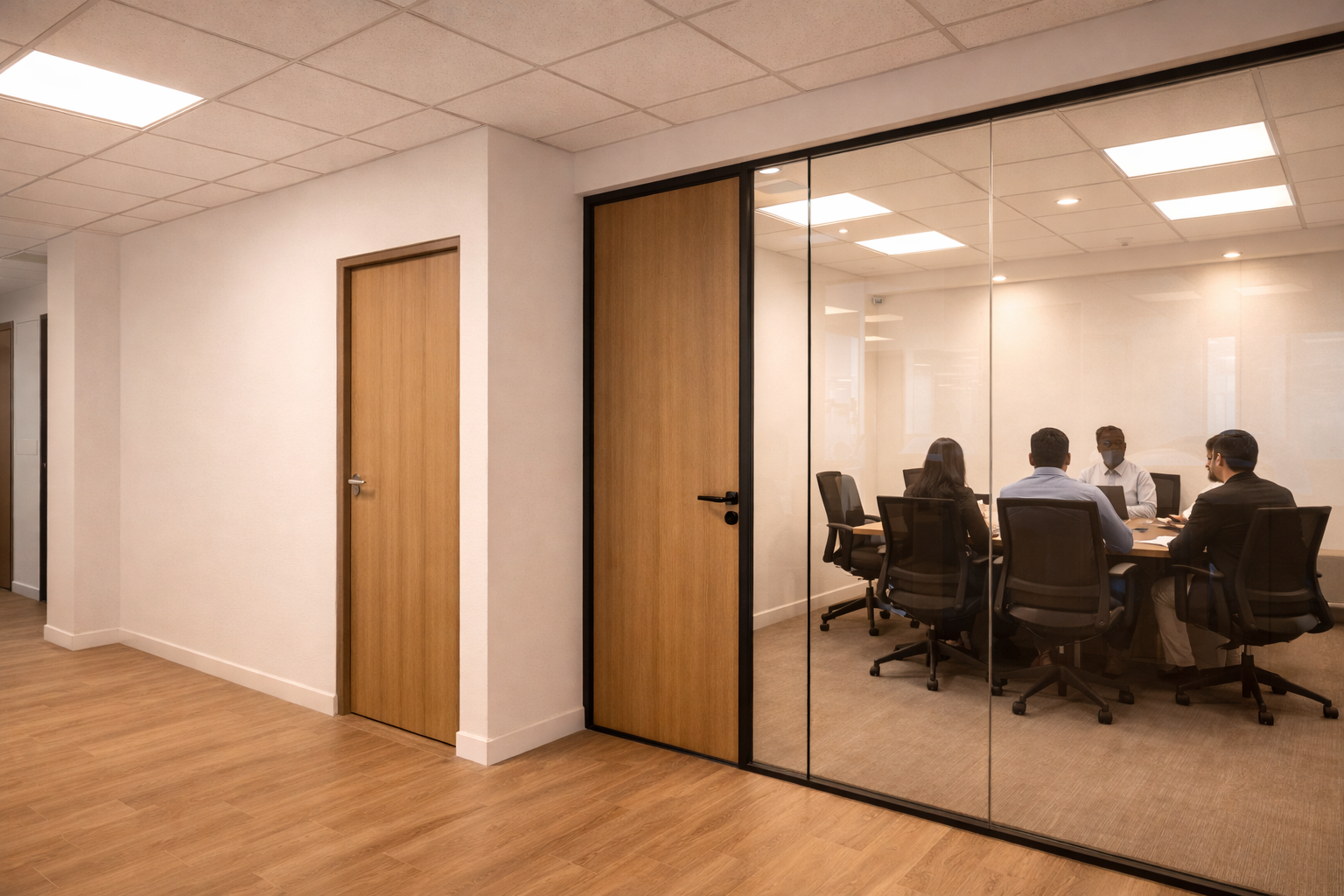
Glass office partitions use tempered or laminated glass panels held in a slim aluminium or steel frame system. They can be floor-to-ceiling or partial-height, single-glazed or double-glazed, clear, frosted, or switchable (smart glass). They allow light to pass between zones, maintain visual connection across spaces, and create a modern, open aesthetic that communicates transparency and collaboration. Glass partitions are widely used in tech company offices, co-working spaces, and any workplace where open sightlines align with the company culture.
Privacy comparison
Gypsum partitions provide complete visual privacy — once the door is closed, there is no visual connection between a cabin and the open office. Glass partitions provide visual connectivity by default — frosted or privacy film options can reduce transparency, but the intent is inherently more open. For HR offices, executive cabins, counselling rooms, and any space where confidential conversations happen, gypsum is the more appropriate choice. For team meeting rooms, collaborative spaces, and offices that want to signal openness, glass achieves this naturally.
Acoustic insulation
This is where gypsum partitions have a clear advantage for most office applications. A gypsum drywall partition with glasswool cavity infill achieves Sound Transmission Class (STC) ratings of 40 to 55, depending on construction — enough to prevent voice conversations from being audible through the wall. A standard single-glazed glass partition achieves STC 28 to 32. Double-glazed glass units improve this to STC 35 to 40, but at significantly higher cost. For conference rooms where confidential discussions occur, or for any space near mechanical equipment or a noisy open office, gypsum's acoustic performance is meaningfully superior to standard glass.
Aesthetic impact
Glass partitions create a premium, modern aesthetic that reads as open, light, and contemporary. They allow natural light to penetrate deeper into the office floor plate, which benefits both wellbeing and energy consumption. Gypsum partitions can look equally premium when well-finished — feature walls with fluted panels, integrated lighting, or textured paint create statement gypsum partition surfaces — but they are fundamentally opaque, which changes the feel of the space significantly. The right aesthetic choice depends on your company's design intent and the message you want the office to communicate to clients, candidates, and employees.
Fire safety
Both systems offer fire-rated variants. Gypsum fire-rated partitions (using two or more layers of fire-rated board) can achieve 60, 90, or 120 minutes of fire resistance — required for server rooms, stairwells, and escape routes. Fire-rated glass is available but is significantly more expensive than standard tempered glass and is typically used in specific locations where visibility and fire resistance are simultaneously required (fire doors, lobby vision panels). For general office partition work, gypsum is more cost-effective for achieving fire resistance ratings.
Which to choose for your Bangalore office
Use gypsum when: acoustic privacy is a priority; the cabin is used for confidential discussions or sensitive work; your company culture is structured and hierarchical; the budget favours a cost-effective solution with excellent acoustic performance; or the partition will have a TV, shelving, or heavy fixtures mounted on it. Use glass when: visual openness and light transmission are priorities; you want to signal a collaborative, transparent culture; the space is a meeting room where visibility from outside is acceptable; or design aesthetics and natural light are primary drivers.
Combining both in one layout
The most effective commercial fitouts in Bangalore often use both materials in the same office — gypsum for executive cabins, HR rooms, server rooms, and any privacy-sensitive space, with glass for meeting rooms, collaborative zones, and reception-facing areas. This combination gives each space the appropriate performance characteristics without forcing a single-material compromise across the entire floor plate.
Elysian's partition expertise
We execute gypsum drywall partitions across commercial offices throughout Bangalore — from single cabins to full floor-plate layouts with multiple room types. Explore our gypsum partition service for technical specifications, or browse our project portfolio for completed office partition examples. For a site visit and partition layout discussion, reach us directly on WhatsApp.
"Planning an office partition in Bangalore? Book a free site visit — we'll help you choose the right partition system for your space."
Book a Free Site Visit